|
||
48. Prismatic Rhabdites |
| Listing of Structures |
| Back...Next |
| Meteorite - Bruno, IIAB, Iron. Meteorite - Walker County, IIAB, Iron. Meteorite - Coahuila, IIAB, Iron. |
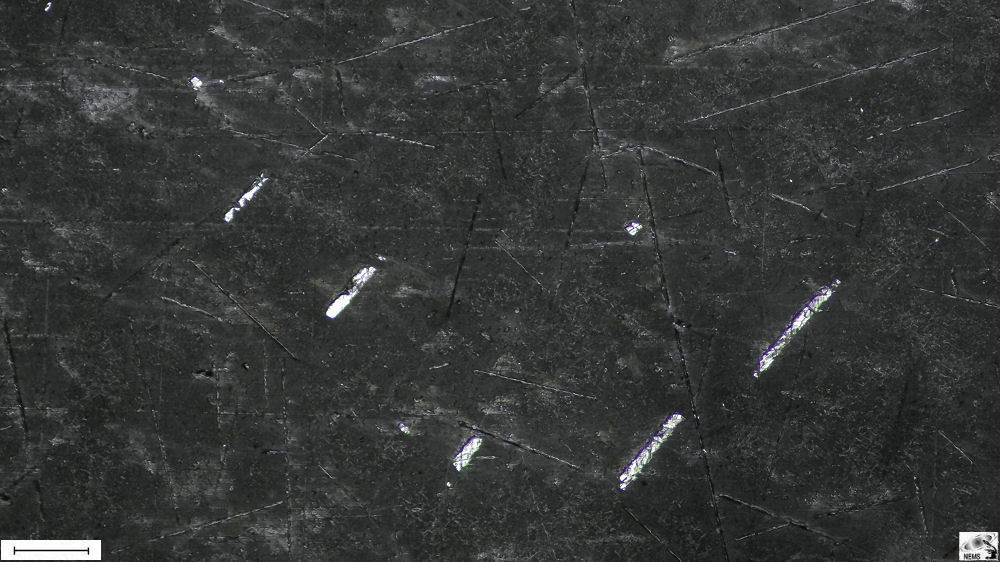
| Figure 1. Scale bar 200 µm. |
| Meteorite: Bruno, IIAB iron |
| Prismatic rhabdites. |
| Prismatic Rhabdites in IIAB Hexahedrite
Iron Meteorites Figure 1. Prismatic rhabdites in the Bruno IIAB iron. Scale bar=200 µm. Figure 2. Prismatic rhabdites in the Bruno IIAB iron. Scale bar=200 µm. Figures 3–4. Prismatic rhabdites in the Walker County IIAB iron. Scale bars=350 µm. Figure 5. Prismatic rhabdites in the Coahuila IIAB iron. Scale bar=300 µm. Rhabdites are morphologically distinctive, rod-like or prismatic crystals of schreibersite ((FeNi)3P), a common accessory phosphide in iron meteorites. In hexahedrites (structurally simple, kamacite-dominated irons with ~5–6 wt% Ni), prismatic rhabdites are particularly prominent and serve as key petrographic indicators of cooling history and minor shock modification. Formation and Crystallization Hexahedrites primarily consist of large kamacite grains with minimal taenite. During the protracted cooling of the metallic core of their parent body (typically at rates of ~1–10 °C/Myr), phosphorus—initially dissolved in the Fe-Ni melt or solid—becomes concentrated in residual liquids. Upon further cooling into the subsolidus regime (~700–500 °C), schreibersite nucleates and grows, often as prismatic rhabdites elongated along preferred crystallographic directions within the kamacite host. The tetragonal symmetry of schreibersite favors anisotropic growth, yielding the characteristic rod- or needle-like (prismatic) habit. Rhabdites and macroscopic schreibersite share the same chemical formula but differ in size, morphology, and nucleation style: rhabdites typically form via homogeneous nucleation within kamacite, while larger schreibersite masses often nucleate heterogeneously at grain boundaries or interfaces. Influence of Shock and Etching Mild shock events, common in the asteroid belt, can deform existing structures, introduce dislocations, or induce localized recrystallization, which may sharpen or redistribute rhabdites. In etched sections (commonly using nitric acid or other reagents), rhabdites stand in relief against the kamacite matrix due to differential etching rates, enhancing their visibility as bright, prismatic inclusions. Presented are examples from classic IIAB hexahedrites—Bruno, Walker County, and Coahuila—to illustrate the consistent development of these features across specimens with similar bulk compositions. Petrogenetic Significance Prismatic rhabdites provide constraints on: • Phosphorus abundance and its partitioning during core crystallization • Subsolidus cooling rates through diffusion-controlled growth kinetics • The relative timing of phosphide precipitation versus Widmanstätten pattern formation (minimal in hexahedrites) In IIAB irons, which represent one of the largest magmatic iron groups derived from a single or closely related parent bodies, these textures complement other indicators such as Neumann bands (shock-induced twins in kamacite) and overall structural simplicity. They highlight the transition from primary igneous differentiation to secondary asteroidal processing. |
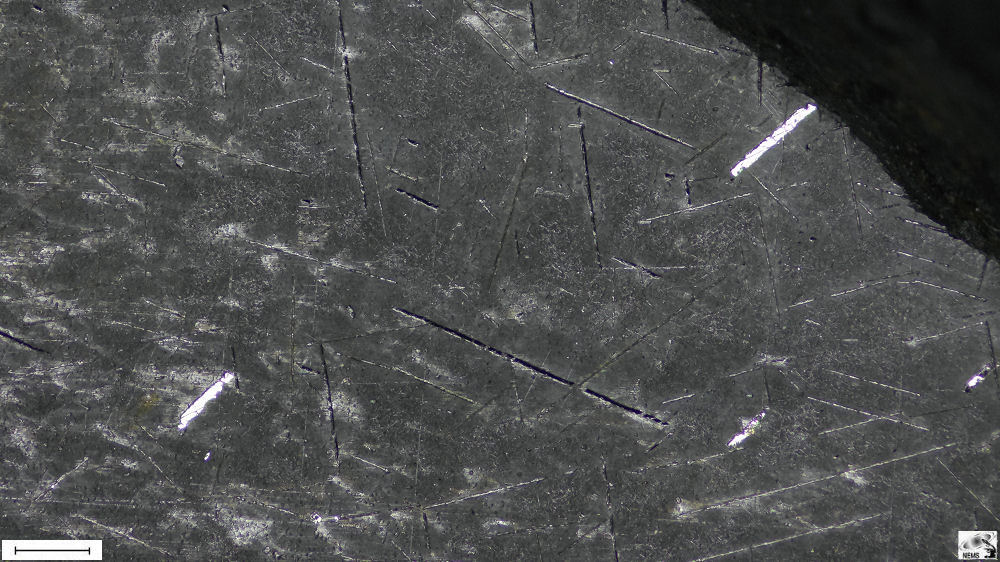
| Figure 2. Scale bar 200 µm. |
| Meteorite: Bruno, IIAB iron |
| Prismatic rhabdites. |
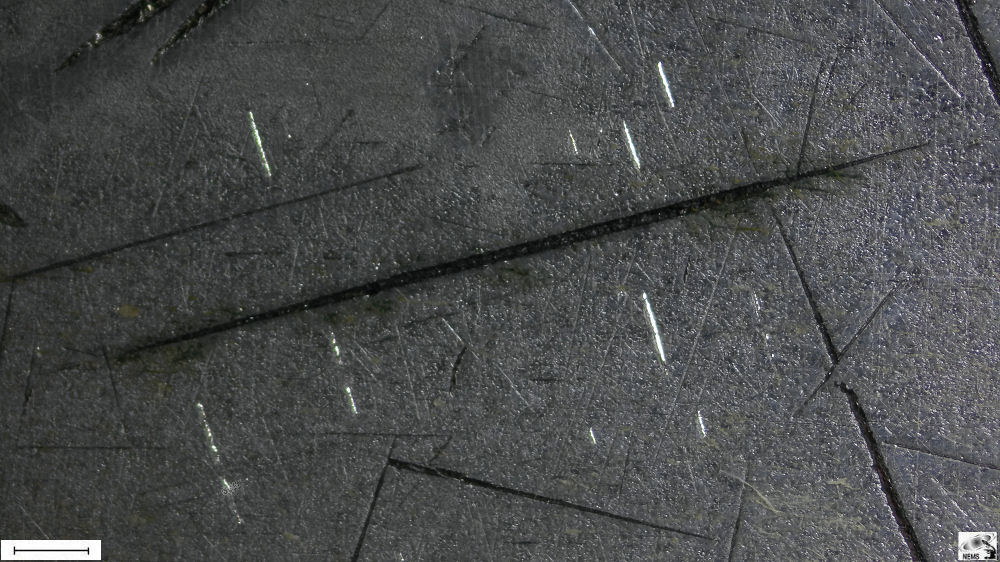
| Figure 3. Scale bar 350 µm. |
| Meteorite: Walker County, IIAB, iron |
| Prismatic rhabdites. |
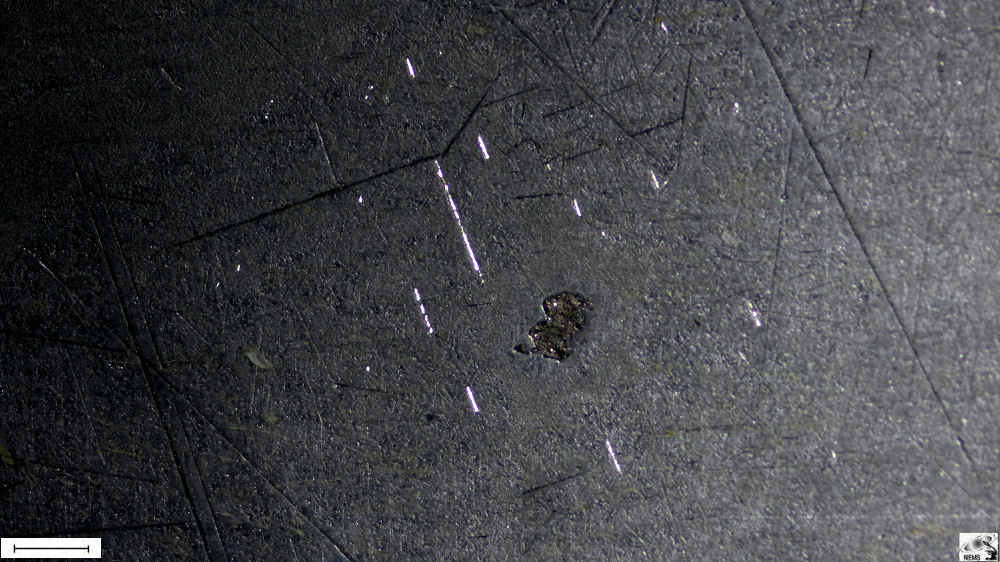
| Figure 4. Scale bar350 µm. |
| Meteorite: Walker County, IIAB iron |
| Prismatic rhabdites. |
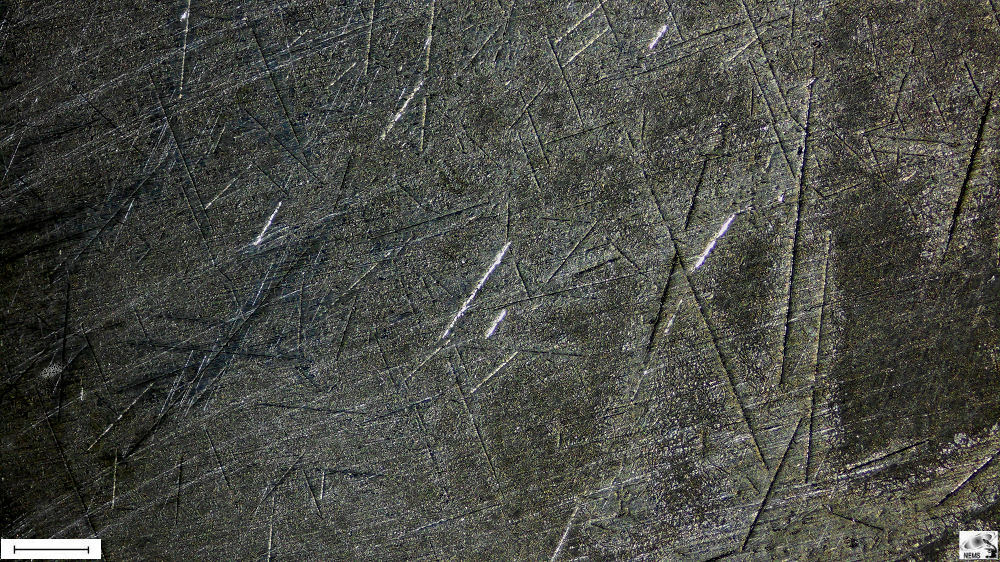
| Figure 5. Scale bar 300 µm. |
| Meteorite: Coahuila, IIAB iron |
| Prismatic rhabdites. |
| References • Buchwald, V. F. (1975). Handbook of Iron Meteorites. University of California Press. (Detailed petrography of IIAB hexahedrites and rhabdites). • Clarke, R. S., Jr., & Goldstein, J. I. (1978). Schreibersite growth and its influence on the metallography of coarse-structured iron meteorites. Smithsonian Contributions to the Earth Sciences, No. 21. (Key reference on nucleation, growth temperatures, and morphologies). • Meteoritical Bulletin Database entries for Bruno, Walker County, and Coahuila (IIAB irons). • Scott, E. R. D. (1972). Chemical fractionation in iron meteorites and its interpretation. Geochimica et Cosmochimica Acta. • Wasson, J. T. (1985). Meteorites: Their Record of Early Solar-System History. W. H. Freeman. |
| Listing of Structures |